
Rise of the Information Architect
16 June 2026

Rise of the Information Architect
For the majority of the 2010s, the "modern data stack" (stupid name, glad we've got other things to think about now) drove a massive expansion in data team headcounts. Convinced that specialization was the only path to maturity, organisations were rapidly redefining everybody's jobs in the data world. It was honestly an absolutely ridiculous time.
Data engineering was twisted into an absolute plethora of bastardised child roles around ingestion or transformation - and even spun out "analytics engineering" as its own distinct discipline. Data analysts and business intelligence developers were twisted apart, and platform architects became commonplace, just to keep the underlying infrastructure from collapsing under its own weight. Data science, for its part, went from a magnificently intelligent super-God-tier role to simply "data analyst who uses Python", unless you were fortunate enough to jump on the machine learning engineer bandwagon and retain your privileged position as the clever person who does stuff nobody else can understand.
I honestly do not think people are really thinking about the results of this shift.
Multi-hop architectures are often bemoaned in technical circles, but organisations created a multi-hop data team. A single business question needs to go through five distinct hands, causing communication overhead, misaligned models, and slow delivery cycles - and all that before we even talk about the CAB processes or prioritisation of work. The industry set about taking advantage of being the new oil, by rapidly adding bodies and building expensive data factories that optimized for the process of moving numbers from point A to point B, rather than optimizing for actual business intelligence.
And, if you think about it, it's probably the only thing that could've happened. The industry has been living in a 15 year capability deficit. Maths and computer science graduates are growing - but nowhere NEAR as fast as data roles are. So the outcome is a lack of technical capability, we have to split the jobs down more granularly, because there aren't enough people that can do all of them!
Pushing Forward
The tectonic plates are shifting. The convergence of unified, low-effort cloud data ecosystems and the rapid maturation of generative AI is bringing about an inevitable collapse of this hyper-specialized structure. In its place, a new archetype can emerge: The Information Architect.
The Information Architect is a single, highly-leveraged professional responsible for designing, building, and governing a complete data ecosystem from raw ingestion to the end-state business layer. They're not a role that should have any direct reports, they're an IC. They manage an AI-turbocharged ecosystem that delivers end-to-end solutions at a pace that was completely unimaginable a few years ago. It's exactly the role that delivers the sorts of ecosystems that I'm building day-to-day, and it's absolutely something that many full-stack data professionals could do.
Commodity Infrastructure and Low-Effort Tools
This radical change in dynamic for data teams is only possible because the underlying engineering grunt work has been, for the most part, abstracted away. In the early days of the cloud data revolution, engineering teams spent weeks configuring virtual machines, tuning cluster configurations, managing partition keys, and maintaining fragile orchestrators. Infrastructure was a full-time job. I know. I used to do it.
Today, platforms like Fabric, Databricks, or Snowflake have effectively turned enterprise data infrastructure into a much simpler beast: "just spool it up!".
Unified SaaS environments have removed much of the technical friction of deployment. Compute auto-scales seamlessly, storage layers open up instant access across ecosystems, and cross-platform shortcuts minimize the need for heavy, repetitive ETL pipelines - and let's be honest, most of those sucked anyway.
Since these environments are low-effort and exceptionally high-capability, the role of the platform administrators or infrastructure engineers has largely disappeared; replaced by the technology itself. An Information Architect can spin up an enterprise-grade lakehouse, establish security boundaries, and configure an ingestion engine in minutes (after the additional overhead of designing it in the first place). The technical overhead has plummeted to near zero and the architect can focus entirely on output, governance, and business value. Actual real value. I think it's fair to say that's been elusive for the data industry for the past 20 years.
AI Coding Machines
If modern enterprise SaaS data platforms remove the infrastructure burden, AI removes the disastrous coding time-sink. Traditional data pipelines required thousands of lines of boilerplate PySpark, SQL, and tool-specific configuration. Even orchestration was a bit of a mess - who remembers SSIS being reduced to a sproc-firing flowchart? Or even better, the dreaded 'sp_master', where the organisation's first and only 20-year-tenured data professional had the entire thing firing from one stored proc. When you consider all the chaos that used to exist, it's incredibly easy to see why we ended up with teams of 5 or 10, even in small organisations.
That's the old world, though. The Information Architect operates at a completely different altitude. They do not spend their days hand-coding syntax; they operate as the director of an AI-driven delivery engine. By writing high-level conceptual designs and precise structural specs, they leverage AI support to generate the required code. Whether it’s auto-generating robust Spark notebooks, writing highly optimized SQL views, or generating metadata-driven orchestration loops, the notable distinction is that the Information Architect is broadly aiming to guide the strategic and architectural approach, with the code being typically AI-generated, then human-reviewed, critiqued, and tested afterwards.
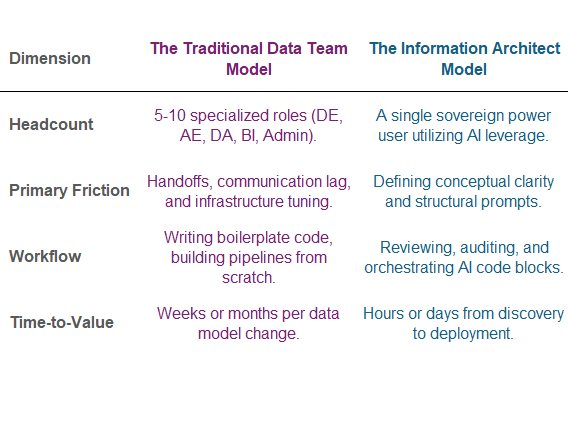
This dynamic shifts the core workflow of data engineering from authoring code to auditing intent. The Information Architect establishes the design patterns, uses or guides the AI to build the implementation, reviews the outputs against strict structural guidelines, and uses code-based CI/CD workflows to push to production. This immense leverage turns a single professional into a pipeline powerhouse, capable of building robust, governed end-state data models at a velocity that makes old-school development cycles look antiquated after a remarkably short period of time.
From Raw Ingestion to the 'Business Speak' Interface
With infrastructure automated and code generation outsourced to AI, the defining value of a data professional has evolved. It is no longer enough to land data cleanly inside a hidden database table and declare success. The responsibility of the Information Architect spans the complete lifecycle.
The architecture must extend unbroken from the raw, messy source systems, move through structured analytical modeling, and culminate in an elegant, contextually rich 'business speak' interface. The Information Architect is, above all else, a semantic translator for a deeply complex technical world.
In an environment dominated by AI, the ultimate objective of a data platform is no longer a static, pixel-perfect dashboard. The end state is a beautifully governed, rich semantic layer or natural-language agent interface. If the business queries an AI assistant in plain English, that assistant relies entirely on the structural boundaries, relationship mappings, and business definitions established by the Information Architect. If the semantic model is weak, the AI's answers will be untrustworthy.
To succeed in this role, the architect must step out of the technical silo and sit deeply within the business domain. They must master the nuances of organizational metrics, understand user workflows, and translate ambiguous commercial definitions into rigid, mathematically sound logical structures. They build the semantic schemas, the metric definitions, and the data validation guardrails that allow business users and AI agents to converse with the underlying data safely and accurately.
Embracing the Data Product
The transition to an Information Architect requires a fundamental psychological shift. Data professionals must start thinking of themselves as organisationally-educated product owners building a digital asset.
- Product over Project: We do not build throwaway, one-off pipelines for individual queries. We construct enduring, system-agnostic assets that continuously deliver reliable insights. It doesn't matter if we bin off Salesforce and adopt D365, we can simply change the source and the data platform should, generally, 'just work'.
- "Trust as our Primary Metric": I hate that quote, it's over-used, but it's undeniable that the ultimate measure of architectural success is not uptime or execution speed; it is human trust. If the business doesn't trust the interface, the platform has failed.
- Designed for Human (and LLM) Consumption: Data structures must be immediately understandable, pristine, and clean; whether parsed by a business executive or an AI reasoning loop.
The Future Belongs to the Information Architects
The rise of the Information Architect, much as I dislike the implication of fewer data roles, is simply a structural necessity. As companies demand faster execution and absolute data accuracy to feed their AI initiatives, the multi-tiered handoffs of traditional data teams are becoming an untenable liability. Actually, no, scratch that. They've long been an untenable liability - but we've just been blindly hoping a new organisational topology or process change will fix it. It won't.
The data professionals who thrive in this next era will be those who show the aptitude to bridge multiple technical disciplines, while being confident and open in their engagement with their customers - the business. Utilising unified ecosystems like Fabric, Snowflake, and Databricks and engaging with the prodigious velocity of AI-assisted engineering, the Information Architect commands the entire platform end-to-end. They stand as the definitive bridge between raw technical infrastructure and meaningful corporate strategy. The original data scientist; a one-man wrecking machine of organisational information.